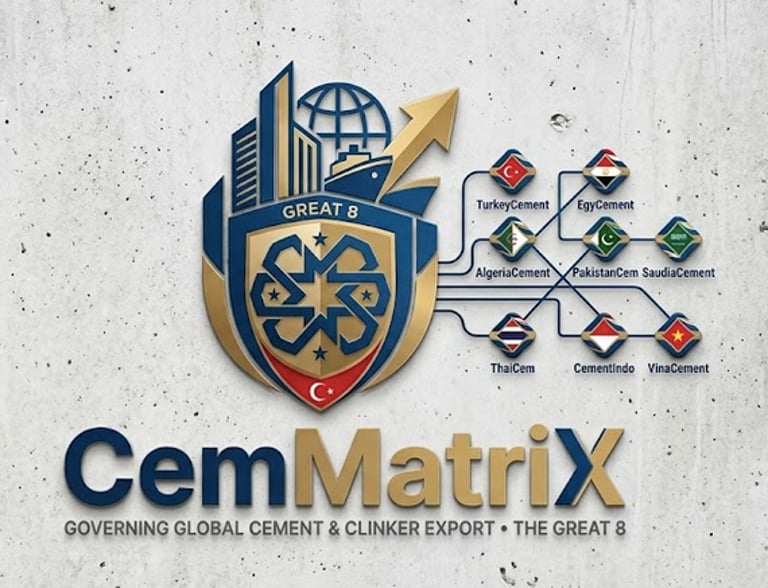
Global Cement and Clinker Supply Across 9 Strategic Export Origins
CemMatrix is a global cement and clinker sourcing network covering Algeria, Egypt, Turkey, Vietnam, Indonesia, Thailand, Saudi Arabia, Pakistan, and Tunisia. We support grinding stations, cement importers, infrastructure developers, commodity traders, and industrial procurement teams seeking FOB and CFR supply from the origin that best matches their project requirements.Looking for Cement or Clinker Supply?
Product
Volume
Destination Port
FOB or CFR
Submit RFQ
Cargo programs range from 10,000 MT coastal shipments to 75,000 MT Panamax cargoes. Rather than promoting a single country, CemMatrix evaluates destination markets, freight economics, cargo size, specification requirements, compliance obligations, and vessel availability to identify the most suitable export origin for each inquiry.
Whether the requirement is Atlantic clinker into West Africa, CBAM-documented cement into Europe, Panamax clinker into Australia, or sulfate-resistant cement for infrastructure projects, the objective remains the same: matching buyers with the origin that creates the strongest commercial outcome.
The CemMatrix Origin Network
Every cement-producing country has strengths and limitations. Freight distance, vessel size, specification requirements, storage capacity, environmental compliance, and destination markets all influence sourcing decisions. The CemMatrix network covers nine export origins, each serving a different commercial role within the global cement trade.
Algeria Cement and Clinker Export
Atlantic-facing clinker and cement supply from Oran, Bejaia, and Skikda. Suitable for West African grinding stations, Southern European importers, and buyers seeking freight-efficient Handymax cargoes. Algeria's port infrastructure and production capacity make it a consistent first-evaluation origin for buyers serving Atlantic and Mediterranean corridors.
Learn more about Algerian clinker and cement exports →
Egypt Cement and Clinker Export
Mediterranean and Red Sea export capability through Alexandria, Damietta, and Ain Sokhna. A strong option for buyers serving both European and East African markets from a single origin. Egypt's dual-sea access creates flexibility for buyers managing multi-corridor procurement programs.
Learn more about Egyptian cement and clinker exports →
Turkey Cement and Clinker Export
Specification-driven cement exports including White Cement, SR5 Sulfate Resistant Cement, Low-Alkali Cement, and CEM I 52.5R. Suitable for compliance-sensitive projects across Europe, North America, and the Mediterranean. Turkish cement producers operate under EU-proximate environmental standards, making Turkey a primary origin for CBAM-documented supply into European markets.
Learn more about Turkish cement and clinker exports →
Vietnam Cement and Clinker Export
Large-scale Panamax clinker exports from Haiphong, Cam Pha, and Vung Tau. Suitable for high-volume grinding stations requiring 50,000–75,000 MT cargo programs. Vietnam is the primary origin for buyers in Australia, New Zealand, and Pacific Basin markets requiring cost-competitive, large-parcel clinker supply.
Learn more about Vietnamese clinker and cement exports →
Indonesia Cement and Clinker Export
Flexible Handymax and Supramax clinker supply supporting Australia, New Zealand, and Pacific Basin importers. Indonesian origins offer competitive pricing and vessel flexibility for buyers managing variable cargo sizes across Southern Pacific routes.
Learn more about Indonesian cement and clinker exports →
Thailand Cement and Clinker Export
Premium cement and clinker supply for infrastructure, marine, and quality-sensitive projects requiring advanced documentation and technical consistency. Thai producers supply to buyers where specification compliance and documentation reliability are primary procurement criteria.
Learn more about Thai cement and clinker exports →
Saudi Arabia Cement and Clinker Export
Red Sea and Arabian Gulf supply positions serving East Africa, GCC markets, and South Asia. Saudi origins provide competitive regional supply for buyers in Djibouti, Mombasa, and Indian Ocean markets where freight distance from Atlantic or Asian origins creates a landed cost disadvantage.
Learn more about Saudi Arabian cement and clinker exports →
Pakistan Cement and Clinker Export
Competitive clinker and OPC supply into East Africa, GCC countries, and the wider Indian Ocean market. Pakistani producers offer cost-competitive supply programs for buyers in Mombasa, Dar es Salaam, and Gulf ports where freight economics favor Indian Ocean origins over Atlantic or Southeast Asian supply.
Learn more about Pakistani cement and clinker exports →
Tunisia Cement and Clinker Export
Mediterranean short-sea clinker and cement supply for storage-constrained terminals requiring frequent medium-volume replenishment. Tunisia's position in the central Mediterranean makes it a practical origin for buyers managing tight storage windows across Southern European and North African import terminals.
Learn more about Tunisian cement and clinker exports →
Which Origin Fits Your Requirement?
The lowest FOB price is rarely the most important factor in cement procurement. Buyers typically evaluate freight cost, vessel size, port draft restrictions, storage capacity, product specifications, environmental compliance, project requirements, and inventory management cycle in combination — not in isolation.
A grinding station in Ghana may compare Algeria and Vietnam. An importer in Mombasa may compare Egypt, Saudi Arabia, and Pakistan. An EU infrastructure contractor may compare Turkey with other CBAM-sensitive origins. An Australian grinding station may evaluate Vietnam, Indonesia, and Thailand.
The correct origin depends on the destination and procurement objective rather than the FOB price alone. CemMatrix evaluates all relevant factors across the full origin network and presents the commercial case for each applicable origin before the buyer commits to a sourcing position.
Why Buyers Compare Multiple Origins
Cement and clinker procurement is not a static decision. The origin that delivered the strongest commercial outcome on the previous cargo may not be the correct origin for the next one. Several factors drive this dynamic.
Freight markets move independently of FOB pricing. A decline in available Panamax tonnage on Pacific routes may make Algerian or Egyptian supply more competitive for buyers who would otherwise default to Vietnamese clinker. Vessel availability at specific loading terminals changes by season, affecting both the cost and feasibility of a cargo program from a given origin.
CBAM obligations are reshaping European procurement. EU importers of cement, clinker, and related materials are now required to account for embedded carbon content under the Carbon Border Adjustment Mechanism. Turkish cement exports, produced under EU-proximate regulatory conditions, carry a measurably different CBAM cost burden than supply from origins operating under less stringent environmental frameworks. For European buyers, this shifts the landed cost comparison in ways that FOB price alone does not capture.
Inventory planning requirements vary by project phase. A construction program in its foundation phase may require large-parcel Panamax clinker supply from Vietnam or Indonesia. The same program in a later phase may require smaller, more frequent Handymax shipments from Algeria or Tunisia to match tighter storage windows.
Destination economics shift over time. Port congestion, storage charges, import duty changes, and local currency movements all affect the landed cost calculation from each origin differently. Buyers who evaluate a single origin at the start of a procurement program and do not reassess at each cargo cycle are frequently paying more than necessary. CemMatrix provides multi-origin comparison at each inquiry stage rather than defaulting to the most recently used supply position.
Major Global Trade Corridors
West Africa Cement and Clinker Imports
Algeria, Egypt, and Vietnam are regularly evaluated for clinker supply into Ghana, Ivory Coast, Senegal, Nigeria, Togo, Benin, and surrounding markets. Origin selection depends on cargo size, vessel availability, and grinding station storage capacity.
East Africa Cement and Clinker Imports
Saudi Arabia, Egypt, and Pakistan support grinding stations and importers in Djibouti, Mombasa, Dar es Salaam, Beira, and neighboring regions. Indian Ocean freight economics typically favor these origins over Atlantic or Pacific supply for East African buyers.
Mediterranean Basin Cement Supply
Turkey, Algeria, Tunisia, and Egypt serve cement importers, construction groups, and grinding stations throughout Southern Europe and North Africa. CBAM documentation requirements are a primary consideration for EU-bound supply in this corridor.
Australia and New Zealand Clinker Imports
Vietnam, Indonesia, and Thailand provide clinker and cement supply programs ranging from Handymax shipments to Panamax cargoes. Cargo size and vessel class are primary evaluation factors for Australian and New Zealand grinding station procurement.
North America Specialty Cement Imports
Turkey and selected Mediterranean origins support specialty cement grades, infrastructure projects, and bulk import programs. Turkish White Cement, SR5 Sulfate Resistant Cement, and Low-Alkali Cement are among the specification-driven grades sourced for North American infrastructure and construction programs.
GCC and South Asia Cement Supply
Saudi Arabia and Pakistan remain important origins for buyers seeking competitive regional supply across Gulf Cooperation Council markets and South Asian import corridors.
Typical Cargo Structures
Different destinations require different vessel classes and parcel sizes. CemMatrix coordinates cargo programs across all standard vessel classes.
Coastal and Handysize Cargoes — 10,000–20,000 MT. Suitable for Mediterranean islands, smaller import terminals, storage-constrained buyers, and short-sea trades. Origins: Tunisia, Algeria, Egypt.
Handymax Cargoes — 25,000–40,000 MT. Suitable for West African grinding stations, East African importers, and regional infrastructure projects. Origins: Algeria, Egypt, Pakistan, Saudi Arabia.
Supramax Cargoes — 40,000–55,000 MT. Suitable for established grinding stations, large import terminals, and multi-port discharge programs. Origins: Vietnam, Indonesia, Thailand.
Panamax Cargoes — 60,000–75,000 MT. Suitable for high-volume clinker consumers, Australian grinding stations, US West Coast imports, and large industrial grinding operations. Origins: Vietnam, Indonesia.
Frequently Requested Products
The CemMatrix network supports procurement of clinker, Ordinary Portland Cement (OPC), CEM I 42.5, CEM I 52.5R, White Cement, Sulfate Resistant Cement (SR5), Low-Alkali Cement, bulk cement, big bag cement, infrastructure cement grades, marine construction cement, and grinding station feedstock. Product availability depends on origin, producer, loading terminal, and shipment schedule.
Current Inquiry Activity
The following categories reflect active procurement inquiries across the CemMatrix network. Each reflects genuine buyer activity and current origin availability rather than promotional positioning.
West Africa Clinker Procurement Programs. Active grinding station inquiry from Ghana, Ivory Coast, and Senegal. Buyers are currently evaluating Algerian clinker against Vietnamese supply on landed cost and vessel availability. Cargo sizes range from 25,000 MT Handymax to 50,000 MT Supramax depending on terminal storage capacity.
Mediterranean Cement Imports. Southern European importers and North African construction buyers are evaluating Turkish cement and Algerian clinker for Q3 and Q4 programs. CBAM documentation requirements are a primary evaluation criterion for EU-bound shipments in this corridor.
White Cement Project Sourcing. Infrastructure and architectural project buyers are sourcing Turkish White Cement for projects requiring consistent specification and documented production traceability. Turkey remains the primary origin for White Cement supply into European and North American markets.
SR5 Sulfate Resistant Cement Requirements. Infrastructure developers working on marine, coastal, and sulfate-exposure projects are sourcing SR5 Sulfate Resistant Cement from Turkey. Active inquiry from Gulf, Mediterranean, and North American project procurement teams.
Australia Grinding Station Replenishment. Australian grinding stations are evaluating Vietnamese clinker and Indonesian supply for Panamax cargo programs. Vessel availability and Pacific freight rates are the primary commercial variables in current evaluation rounds.
East Africa Import Programs. Importers and grinding stations in Mombasa and Dar es Salaam are comparing Saudi Arabian, Pakistani, and Egyptian supply on CFR landed cost. Indian Ocean freight economics are currently favoring Red Sea origins for this corridor.
Long-Term Clinker Supply Agreements. Grinding station operators seeking supply security are approaching CemMatrix for structured annual programs across multiple origins. Multi-origin programs reduce exposure to single-origin supply disruption and provide freight flexibility across cargo cycles.
CBAM-Compliant European Supply Chains. EU importers requiring documented embedded carbon content for CBAM compliance are evaluating Turkish cement as the primary origin meeting both specification and environmental documentation requirements for European infrastructure procurement.
Who We Work With
CemMatrix supports grinding stations, cement importers, construction companies, infrastructure developers, commodity traders, government procurement projects, industrial distributors, engineering contractors, ready-mix producers, and international trading houses. Typical inquiries range from single cargo purchases to annual procurement programs exceeding 500,000 MT.
Submit a Cement or Clinker RFQ
To receive an origin recommendation and commercial indication from CemMatrix, provide the following where available: product required; grade specification; volume; destination port; shipment window; trade basis (FOB or CFR); vessel preference if applicable; compliance requirements; and packaging requirements.
Each inquiry is reviewed against available export origins, freight conditions, vessel availability, cargo size requirements, and destination market economics across all nine origins in the network — Algeria, Egypt, Turkey, Vietnam, Indonesia, Thailand, Saudi Arabia, Pakistan, and Tunisia.
The objective is not simply to find supply. The objective is to identify the origin that delivers the strongest commercial result for the specific trade corridor.
Submit your cement or clinker sourcing inquiry at CemMatrix RFQ →