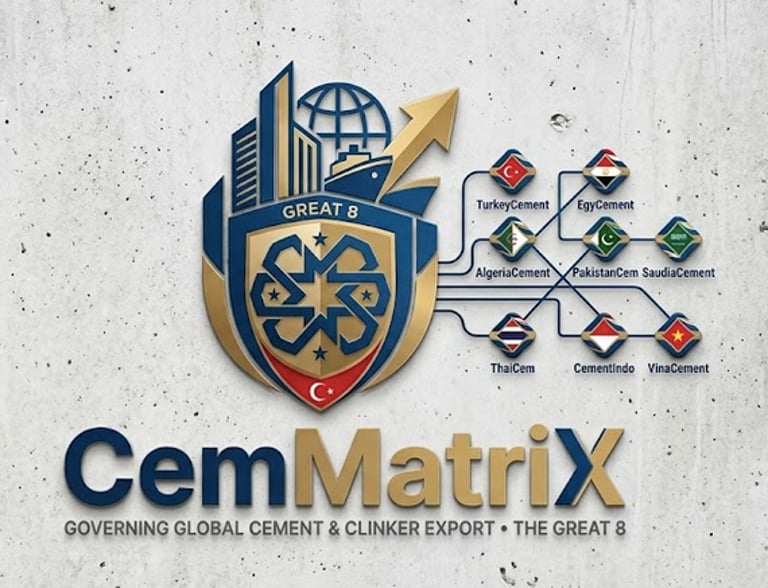
How CemMatrix Evaluates Cement and Clinker Origins: Freight, Compliance, and Procurement Logic
Not every cement or clinker requirement should be sourced from the same origin. A destination that favors Algeria today may favor Egypt six months later. A buyer evaluating Turkey may discover that compliance requirements outweigh freight advantages. The purpose of CemMatrix is not to promote one country, but to evaluate which origin is commercially suitable for a specific procurement requirement.
This framework explains how multiple origins are evaluated across freight economics, documentation requirements, regulatory exposure, vessel practicality, and procurement feasibility.
Why Origin Selection Is a Procurement Decision
Many buyers begin with an origin already in mind. In practice, however, cement and clinker procurement is rarely an origin decision. It is a destination decision influenced by freight costs, technical requirements, delivery timing, compliance obligations, and cargo structure.
The question is not "Which country exports cement?" The question is "Which country is commercially suitable for this cargo?"
The Five Variables CemMatrix Evaluates
1. Freight Economics
Ocean freight frequently determines whether an origin remains competitive after loading. A lower FOB price can become irrelevant if vessel availability, bunker costs, transit distance, or discharge constraints increase the final landed cost.
2. Documentation and Compliance
Many procurement decisions are driven by documentation requirements rather than price. ASTM standards, EN 197 requirements, project documentation, inspection protocols, carbon reporting, and CBAM-related obligations can significantly influence origin selection.
3. Product Specification
Grinding stations, import terminals, infrastructure projects, and distributors often require specific strength classes, chemistry profiles, or certification pathways. An origin that satisfies one market may not satisfy another.
4. Vessel and Cargo Practicality
Cargo structure influences origin suitability. Bulk clinker, bulk cement, big bags, 50 kg bags, and mixed shipments each create different logistical requirements. Port draft, vessel class, loading rates, and discharge capability must be considered together.
5. Supply Continuity and Scheduling
Some buyers require a single cargo. Others require annual programs. Production flexibility, scheduling reliability, and cargo continuity frequently influence procurement decisions more than headline FOB pricing.
Case Study: Turkey vs Algeria for Europe
Turkey and Algeria illustrate one of the most common procurement trade-offs in the Mediterranean market.
Algeria often benefits from straightforward freight economics and competitive clinker positioning. Turkey frequently becomes attractive when documentation depth, ASTM or EN consistency, project compliance requirements, or CBAM-related reporting become important.
In these situations, the decision is no longer driven by freight alone. Compliance and documentation become procurement variables equal to price.
When Turkey May Be More Suitable
CBAM-sensitive procurement programs
Projects requiring extensive documentation packages
ASTM or EN consistency requirements
Buyers prioritizing certification and traceability
When Algeria May Be More Suitable
Standard structural clinker procurement
Freight-sensitive Mediterranean cargoes
Buyers prioritizing landed-cost efficiency
Straightforward procurement programs with limited compliance complexity
Case Study: Algeria vs Egypt for West Africa
West Africa represents a different procurement problem. Here, freight, transit time, and cargo availability often become more influential than regulatory requirements.
Both Algeria and Egypt are relevant origins, but they compete on different strengths.
When Algeria May Be More Suitable
Atlantic-facing freight advantages
Shorter transit times to many West African destinations
Standard clinker procurement programs
Grinding-station feedstock requirements
When Egypt May Be More Suitable
Greater production flexibility
Broader scheduling options
Larger recurring procurement programs
Buyers prioritizing supply continuity over transit-time advantage
Why No Origin Wins Every Time
The objective of procurement evaluation is not to identify a permanently superior origin. Every origin wins under specific commercial conditions and loses under others.
An origin that is optimal for Ghana may be unsuitable for Italy. An origin that is ideal for a grinding station may be inappropriate for an infrastructure project. Freight, compliance, specifications, cargo structure, and timing all influence the result.
The CemMatrix Evaluation Model
CemMatrix evaluates origins through a multi-origin framework rather than a single-origin sales model.
The process begins with the buyer's requirement, not with a preferred country.
Destination → Specification → Freight → Documentation → Cargo Structure → Origin Selection
This methodology allows multiple origins to be evaluated consistently before procurement decisions are made.
Multi-Origin Procurement Is the Core Function of CemMatrix
The CemMatrix network exists to compare origins, identify trade-offs, and determine which export source is commercially suitable for a specific requirement.
The objective is not to promote Turkey, Algeria, Egypt, Saudi Arabia, Pakistan, Vietnam, Indonesia, Thailand, or Tunisia individually. The objective is to determine when each origin is commercially rational and when another origin may be more suitable.