Multi-Origin Cement & Clinker Procurement Framework
CemMatrix is a multi-origin procurement evaluation network for cement and clinker supply. The network does not operate as a cement plant, manufacturer, or single-origin exporter. Its purpose is to evaluate which export origin is commercially suitable for a buyer's destination, specification, cargo size, timeline, documentation requirement, and freight position.
In international cement and clinker trade, the correct origin is rarely determined by FOB price alone. A cargo that appears competitive at the loading port may become unworkable once ocean freight, vessel availability, discharge constraints, documentation requirements, CBAM exposure, product chemistry, and delivery timing are considered together.
CemMatrix exists to structure that evaluation.
What CemMatrix Is
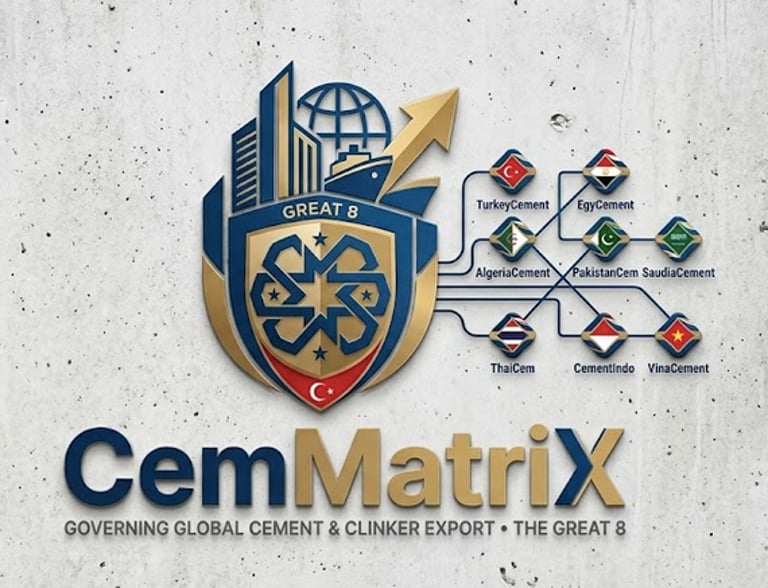
CemMatrix is the central procurement intelligence hub behind a network of origin-specific cement and clinker sourcing nodes.
Each node focuses on one export origin and its natural trade corridors. The hub connects those origin nodes into a wider evaluation framework, allowing buyers to compare origins before committing to a procurement path.
The core function is not to promote one country. The core function is to determine which origin is commercially rational for a specific requirement.
The CemMatrix Origin Network
The CemMatrix network evaluates cement and clinker supply across nine strategic export origins:
These origin nodes are not isolated websites. They are structured as specialized origin desks within a broader procurement evaluation model.
Why Multi-Origin Evaluation Matters
Cement and clinker procurement is a landed-cost decision. A buyer may begin by asking for a specific origin, such as Algeria, Turkey, Egypt, Vietnam, Pakistan, or Saudi Arabia. But once the requirement is reviewed, another origin may become more suitable.
The right answer can change according to destination port, vessel class, loading rate, discharge capacity, customs requirements, standards, carbon reporting, seasonal availability, and freight volatility.
A serious procurement decision must therefore compare origins, not simply collect prices.
How CemMatrix Evaluates Cement and Clinker Origins
The CemMatrix evaluation framework reviews each requirement across several procurement variables.
1. Destination and Port Constraints
The destination port determines much of the sourcing logic. Draft restrictions, berth availability, discharge method, storage capacity, inland transport, and customs clearance can change which origin is practical.
A destination that can receive Supramax or Panamax cargo may allow large-volume clinker sourcing from distant origins. A smaller port may require Handysize vessels, partial cargoes, bagged cement, or a closer short-sea origin.
2. Freight Economics
FOB price is only one part of the equation. Ocean freight, bunker exposure, canal routing, demurrage risk, loading speed, and discharge delays can change the final landed cost materially.
An origin with a lower FOB price may lose its advantage if the freight leg is too long or vessel availability is poor. A nearby origin with a slightly higher FOB price may still win if it reduces transit time, demurrage exposure, and working-capital pressure.
3. Product Specification
Clinker and cement are not interchangeable commodities in technical procurement. Buyers may require specific strength classes, alkali limits, C3S levels, C3A ranges, MgO limits, free lime control, setting time consistency, or compatibility with local grinding conditions.
For finished cement, common requirements may include ASTM C150, ASTM C595, EN 197-1, national standards, GSO standards, SLS, AS 3972, or project-specific specifications.
4. Documentation and Compliance
Some buyers require standard commercial documentation. Others need deeper technical and regulatory packages, including test certificates, SGS or Intertek inspection, origin documentation, carbon data, CBAM-related information, chromium values, or project-specific compliance files.
This is one reason origin selection cannot be reduced to price. A technically suitable cargo may still be unsuitable if documentation cannot support the buyer's import or project requirements.
5. Cargo Structure and Vessel Class
CemMatrix evaluates whether the requirement is better served by bulk clinker, bulk cement, big bags, 50 kg bags, mixed cargo, breakbulk shipment, or terminal-based discharge.
Typical vessel classes may include Handysize, Handymax, Supramax, Panamax, coaster vessels, or specialized cement carriers depending on cargo type and destination constraints.
6. Procurement Timing and Supply Continuity
Some requirements are spot cargoes. Others are quarterly or annual supply programs. A one-time shipment and a recurring grinding-station feedstock program should not be evaluated the same way.
For recurring supply, origin reliability, scheduling flexibility, loading consistency, and document repeatability may be more important than a single low FOB indication.
Origin Evaluation Is Not Origin Promotion
A core principle of CemMatrix is that no origin is always the correct answer.
Algeria may be commercially strong for West Africa when Atlantic freight and standard clinker requirements align. Turkey may be more suitable when documentation depth, ASTM or EN 197 consistency, or CBAM-related reporting is critical. Egypt may be preferred when production flexibility and scheduling options matter. Vietnam may be competitive when scale and long-haul clinker availability dominate the calculation. Pakistan or Saudi Arabia may become relevant for East Africa depending on Indian Ocean freight, availability, and specification requirements.
The purpose of the framework is to identify where each origin wins, where it loses, and where a multi-origin comparison is required before a sourcing decision is made.
Examples of Multi-Origin Procurement Questions
A grinding station in West Africa may compare Algeria and Egypt for clinker supply.
An EU-linked buyer may compare Turkey and Algeria where CBAM, documentation, freight, and carbon reporting affect landed cost.
An East African importer may compare Pakistan and Saudi Arabia for Indian Ocean freight economics and cargo availability.
An Australian buyer may evaluate Vietnam, Indonesia, and Thailand based on scale, freight distance, chemistry consistency, and vessel practicality.
These are not generic market comparisons. They are procurement decision problems.
Hub and Node Structure
CemMatrix functions as the hub. The origin nodes function as specialized country desks.
The hub explains the evaluation logic, cross-origin comparison, sourcing methodology, and procurement framework. The nodes provide origin-specific corridor intelligence, port logic, documentation considerations, and destination suitability.
This structure allows the network to answer two different questions:
Can this origin work for my requirement?
Should this origin be selected instead of another origin?
The first question is answered mainly by the origin nodes. The second question is answered by the CemMatrix hub.
When a Multi-Origin Review Is Required
A multi-origin review is especially important when:
The buyer has not fixed the origin yet.
The destination can receive cargo from multiple trade lanes.
Freight volatility may change landed cost.
Both cement and clinker options are being considered.
Documentation, CBAM, ASTM, EN 197, or national standards may affect eligibility.
The cargo is part of a recurring supply program rather than a one-time purchase.
The buyer needs a realistic landed-cost comparison rather than a simple FOB quotation.
The CemMatrix Procurement Evaluation Output
A CemMatrix evaluation does not begin with a preferred origin. It begins with the requirement.
The output may include:
Most suitable origin shortlist
Alternative origin risk review
Likely vessel class and cargo structure
Freight-sensitive decision variables
Specification and documentation concerns
Procurement feasibility notes
Recommended next-step RFQ structure
Why This Framework Exists
International cement and clinker supply is fragmented. Producers, traders, importers, grinding stations, and project buyers often evaluate the same requirement from different angles.
CemMatrix creates a structured way to compare those angles across multiple origins.
The goal is not to make every origin appear suitable. The goal is to identify the origin that can realistically support the buyer's destination, product, volume, standard, timeline, and procurement structure.
Request Multi-Origin Evaluation
If your requirement involves cement, clinker, bulk shipment, bagged cement, grinding-station feedstock, or destination-specific import planning, CemMatrix can review the origin options through a multi-origin procurement framework.